Study Programs with a Future

Updated on May 15, 2025
Table of Contents
Definition
Future-oriented degree programs are supposed to offer good job prospects and attractive salaries. In general, academics have a below-average share of the unemployment rate, although this naturally depends heavily on economic developments.
This means that job prospects for graduates are good in (almost) all fields. The so-called STEM subjects (science, technology, engineering, and mathematics) particularly fit this statement. Nevertheless, many other degree programs are equally in demand and meet these criteria.
In the last few years, study programs that explore the intersection of data analysis and AI have also risen in popularity. This is owing to general changes in the job market and an increase in demand for employees who have future-forward digital skills.
What are mass study subjects?
Mass-market subjects are, as the name suggests, popular degree programs that are attended and completed by large numbers of students each year. This poses a risk when looking for a job, as the graduate market is very large and additional qualifications and grades are very important. Examples of such programs include business administration or economics.
Factors
There is a checklist of factors that need to be taken into account in order to find out what constitutes a degree program with a future.
-
Job Market
The development of the job market should be closely monitored when choosing a course of study. Generally speaking, the so-called STEM courses have been the undisputed leader among future-oriented degree programs for years.
Other popular degree programs include business administration, economics, and psychology.
STEM degree programs
As mentioned above, the acronym stands for mathematics, computer science, natural sciences, and technology. These primarily refer to degree programs that drive progress and innovation, which is why they are considered very future-proof. These include, for example, the following degree programs:
- Physics
- Mechanical engineering
- Electrical engineering
- Mathematics
- Industrial Engineering
- Biology
- Computer science
- Chemistry
But as mentioned above, non-STEM degree programs continue to be popular choices in 2025. These include, for example, medicine, law, and teaching. The expertise of these graduates is very difficult to automate, making the course of study a very safe choice.
-
Salary
The table shows the gross annual salary in euros including holiday pay and other bonuses for the respective sector.
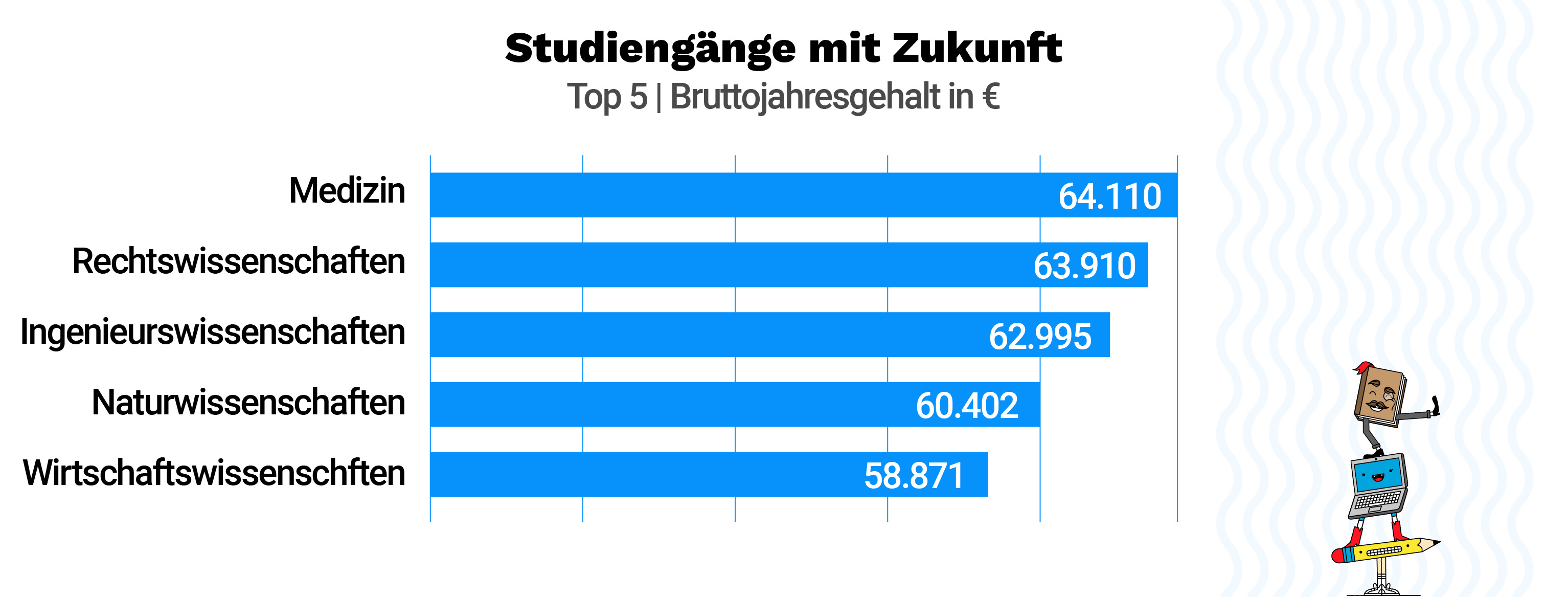
Key:
- Bruttojahresgehalt - Gross annual salary
- Medizin - Medicine
- Rechtswissenschaften - Law
- Ingenieurwissenschaften - Engineering
- Naturwissenschaften - Natural Sciences
- Wirtschaftswissenschaften - Economics
As already mentioned, doctors are not in high demand, but rank first among the top earners with a gross annual salary of €64,110.06, closely followed by IT and engineers. Nursing and therapy are in the lower bracket at €33,445.91.
The gross annual salaries listed in the tables are guidelines and may vary. The actual salary depends on many factors, including location and additional qualifications (professional experience, internships, grade point average).
-
Interests
Personal passion plays an important role, even though salaries among academics vary considerably. Social workers, for example, earn on average only half as much as industrial engineers.
Even though career prospects are a factor that shouldn't be overlooked, it's important to choose a course of study that truly interests you and that you can imagine yourself working in. As already mentioned, there are numerous degree programs that, even though they aren't STEM subjects, will always be in demand and are well-paid. The good news is that the unemployment rate among graduates is very low, so anyone can find a subject they enjoy and with which they can successfully launch their career. A lack of interest will only lead to a lack of motivation, and students will either drop out of college or graduate with poor grades. If this is the case, it's advisable to pursue a different educational path.
Unemployment Rate & Economic Conditions
Your choice of study program is connected to your potential of employment. Your potential to be employed is impacted by economic conditions of the city/state/country you reside in, and more broadly, the global economic conditions.
In Germany, unemployment has risen to 6.3% as of March 2025 (Source: DW). While losses are clearly most strongly felt in the automotive industry, this is the second year of Germany grappling with a contracting job market and a relatively high number of unemployed individuals. This is reflected globally, as well, with the global unemployment rate remaining stable at 4.8% - a figure that has not changed much since March 2023.
While the unemployment metrics should not necessarily deter you from pursuing a study program you're passionate about, it is wise to exercise caution. If you find out that your study program has high rates of unemployment (irrespective of region), then it is better to opt for a different program.
Find a full list of college majors, ranked by employability here.
But remember: correlation is not causality. Soil science comes up on top, with an unemployment rate of only 0.37%. Meanwhile, clinical psychology has an unemployment rate of 9%. While this is not particularly encouraging for aspiring psychologists, do keep in mind that the number of people pursuing a degree in soil science is likely to be a fraction of the number studying psychology.
Summary
It's certainly important to know how future-proof your dream degree program really is. The current market and economic situation play an important role, but you shouldn't let salary prospects alone influence your decision and should choose a degree program that matches your interests.
It's not advisable to study a STEM subject just to have good job prospects. If there's a course you're passionate about, you should choose that. The unemployment rate among graduates is very low, which puts you in a good position, especially with additional qualifications like internships or part-time jobs.
To increase your chances of success and boost your grades at university, check out Studydrive.
Here you will find many, many free study materials, exercise sheets, solutions to old exams and you can exchange ideas with other students.