Speed Reading

Table of Contents
Speed reading is a technique that enables very fast reading without compromising text comprehension. Experienced readers can manage 800–1,500 words per minute, while the average reading speed is around 250 words per minute. The world record for speed reading is held by Anne Jones, who read "Harry Potter and the Deathly Hallows" in 47 minutes. That's approximately 4,251 words per minute. That's quite astonishing!
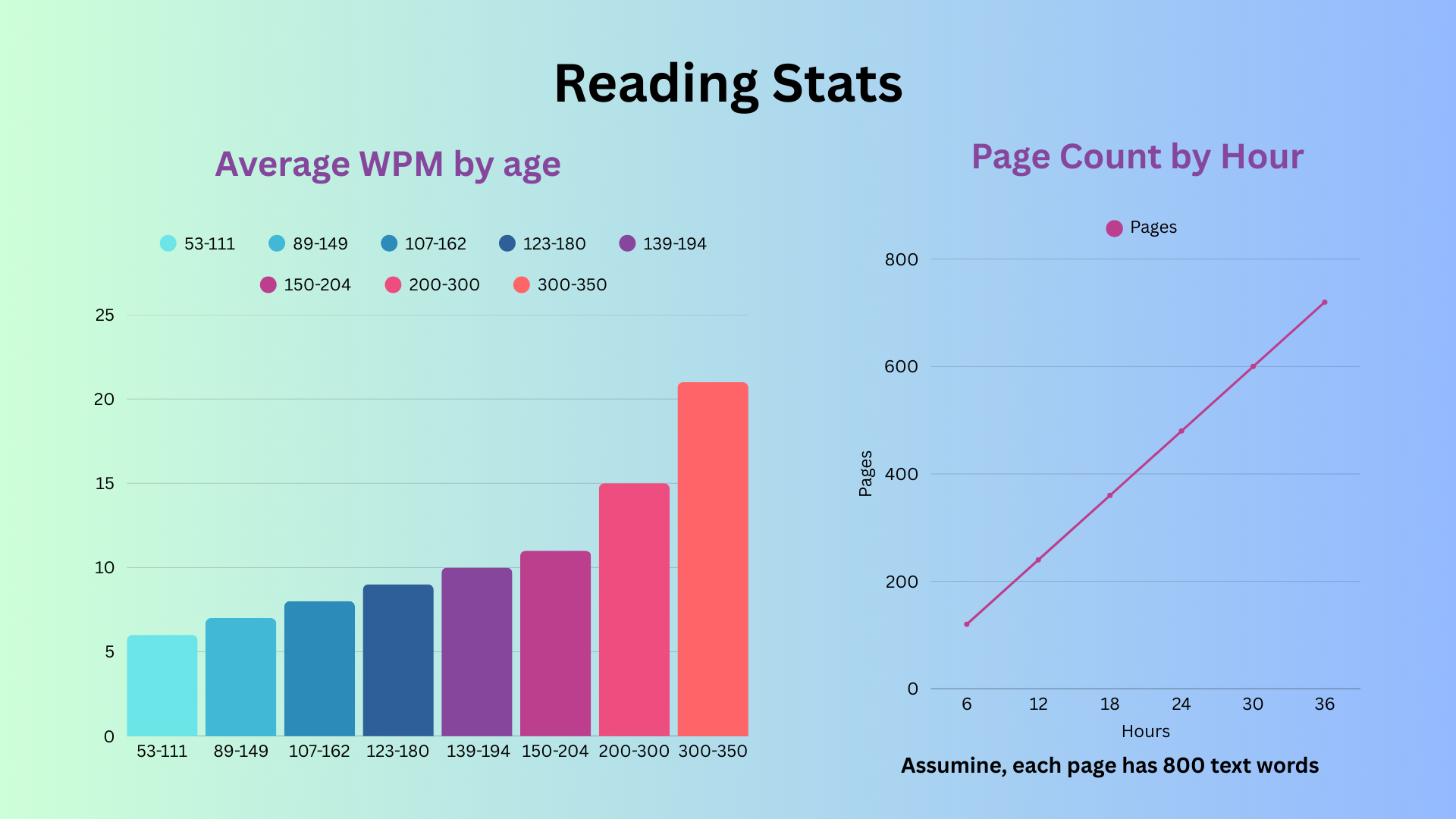
Statistics about how we read. Source: Scholar Within
One thing is certain: In a time when the flood of information is ever increasing, it can't hurt to engage with the topic of speed reading.
Advantages & Disadvantages of Speed Reading
Advantages
Those who can read quickly get their work done faster and therefore work more efficiently. Speed reading also helps you retain what you've read for longer. You've probably forgotten what a book was about five minutes ago while reading. This is a clear sign that you're reading too slowly and your brain isn't being challenged enough. For this reason, your brain begins to focus on other things. This means that speed reading promotes concentration.
Disadvantages
Speed reading requires a high level of concentration. However, if you read too fast, so that you can't process all the information in your head, your comprehension of the text will decrease. When speed reading, you literally let your eyes glide over the text. This can cause headaches in some people with long texts. Be sure to take a break if you notice this and rest your eyes.
Basics of Speed Reading
If you want to learn speed reading, you should first familiarize yourself with the following basics: regression, chunking, subvocalization, and fixation. Then you can work on learning other speed reading techniques to gradually increase your speed. But what do all these terms actually mean?
Regression
Regression refers to jumping back in time within a text. You reread something you've already read because you think you haven't absorbed all the information. This jumping back in time usually happens unconsciously and, of course, costs you valuable time. After rereading a passage, you often realize that you didn't need to read it again. If you just kept reading, everything would have become clear from the context. How can you reduce or even completely eliminate regression? It helps to realize that regression is unnecessary in most cases. It's better to finish reading the entire paragraph before deciding whether to read a section a second time. Most of the time, you've already done it anyway. If you find yourself rereading passages more than once, you might want to increase your reading speed. This puts more strain on your brain. If that doesn't help, it's time for a short break.
Chunking
In elementary school, you're taught to read word for word. However, this style of reading makes it harder to understand the text. The number of times you focus your eyes is also very high, which causes you to read more slowly. Much better is so-called "chunking," where you try to grasp longer phrases of text at once. If you want to improve your reading speed, there's no way around this technique. How long such a phrase should be depends on the sentence structure. If you want to learn chunking, you should first consciously try to grasp at least three words at a time, even if the three words don't yet make sense. If you manage to do this subconsciously, try to break away from the fixed number of words and grasp a passage of text meaningfully. This technique also expands your eye span.
Subvocalization
When you subvocalize, you mentally repeat the text you are currently reading silently. This can also be expressed through lip movements. While this helps with comprehension, it also slows you down. It's scientifically proven that we can read faster than we can speak. To break yourself of subvocalization, you can chew gum while reading to keep your mouth muscles occupied. Unfortunately, there's no simple trick to stop your mind from speaking along. The only thing that helps is paying conscious attention to it. Over time, you'll get rid of this habit, too.
Fixation
If you think your eyes move smoothly forward while reading, you're wrong. In fact, your eyes jump forward in the text. This means you always fixate on a certain number of words that you can clearly see, while everything outside of this range appears blurry. Such a fixation lasts an average of 200-300 milliseconds. The normal eye span is about 4 cm. With targeted training, this can easily be extended to 10 cm or more. People with a large eye span can naturally take in more text at once. Thus, chunking and fixation are closely related.
Quickly grasp important content
With these basics, you can significantly improve your reading speed, but there's more to it. Below are some more tips to help you grasp the most important content of a text. These are especially useful for technical literature, but you can also apply them to other texts.
Skimming
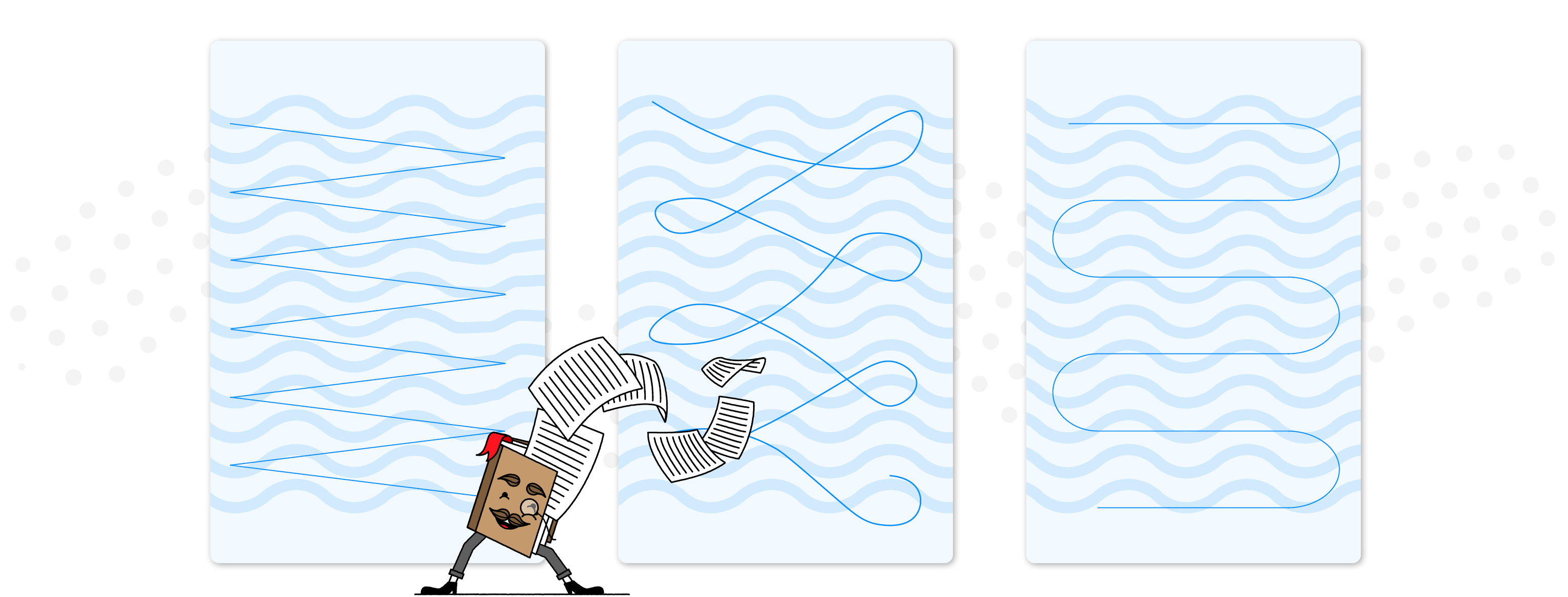
Since you usually don't have to read the entire text from cover to cover, skimming will definitely help you. The term "skimming" is derived from the English word "to skim" and means to skim over. The text is skimmed. This allows you to quickly gain an initial overview. While you can skim line by line from top left to bottom right, just like when reading, diagonal skimming is faster. There are various variations, which you can see in the diagram below. The blue lines correspond to your eye movements. Just try it out and see which variation is most useful for you.
Scanning
Another reading method is scanning. You use this method when you're specifically looking for specific information in a text. If available, you should first look at the table of contents to identify the chapters that might contain the information you're looking for. Then, look at the beginning and end of each paragraph in each chapter to decide whether you want to examine that paragraph more closely.
Reading Aid
You've probably watched an elementary school student read. The index finger is often used as a reading aid, but some adults still do it. This is nothing to be ashamed of, because a reading aid can be helpful for speed reading. With a reading aid, you can set your reading pace. Simply move your index finger a little faster than you usually read and try to read at the same speed. You can also use a ruler or pen.
Some speed readers use this type of reading aid to read two lines at once. The reading aid is simply placed one line down. This requires a lot of practice, however. Another very popular option is a double-sided reading aid, which allows you to always mark the beginning and end of a line. Combined with an eye span that encompasses the entire line, you can progress through the text quite quickly without slipping off the line.
More Tips
Tracking Progress
Before you begin working on your speed reading skills, you should determine your current reading speed. This is measured in words per minute. Find a text with at least 500 words and time the time it takes you to read it completely. Next, give the same text to another person who also reads it. They will then create a short questionnaire with at least ten questions (no multiple choice). If you answer more than 80% of the questions correctly, you can record your measured reading speed in a table with today's date. If you answer less than 70%, you should definitely repeat the process with a new text. There are certainly several online resources that you can use to determine your reading speed, including questionnaires. You should record your progress regularly.
Reading Environment and Breaks
A well-lit environment is very important when reading to protect your eyes. If you plan to read a challenging text, it's best to do so when you're fully awake. You should hold the book about 50 cm from your eyes. Also, take a short break every 30-60 minutes, as every muscle needs a rest.
Eye Training and Relaxation Exercises
Near-Far Exercise: In this exercise, you alternately look at objects that are within a radius of about 50 cm and more than 2 m away. You can also do this exercise on the go.
Border Exercise: Take an open book in your hand and outline the edges of the book with your eyes. Perform this exercise three to five times, changing directions. If you like it more challenging, you can move your eyes in opposite directions.
If you're looking for relaxation exercises for your eyes, a massage or palming your eyes is suitable. You can learn how to do this in practice in André Kursch's video course "Read Fast, Understand More" on Linked Learning. This course also includes more exercises and guides you step-by-step through the topic of speed reading. The video is accompanied by a comprehensive 109-page PDF file.
Book Recs
If you want to delve deeper into the topic of speed reading, we recommend the two books "Speed Reading" by Tony Buzan and "Optimal Reading" by Ernst Ott. But never forget that speed reading shouldn't be the norm. Take the time to enjoy your favorite novel in peace.
Here are some other books about speed reading:
- Super Reading Secrets (Howard Stephen Berg)
- Breakthrough Rapid Reading (Peter Kump)
- Speed Reading for Dummies (Richard Sutz)
- 10 Days to Faster Reading (Abby Marks-Beale)
Do you want to improve your grades at university and are looking for the perfect study materials for your degree program? Then check out Studydrive. Here you'll find tons of free study materials, worksheets, past exam solutions, and the opportunity to exchange ideas with other students.