Exam Prep FAQs: Study Tips and Revision Methods

A guide to surviving exam season. Read through these FAQs to learn more about secret study tips, managing exam stress, and how you can use Studydrive to ace finals!
How to create a revision timetable?
The important thing to keep in mind when creating a revision timetable is to make one that is tailored to your needs and study habits.
- Make sure to develop a schedule that you can sustainably follow without over-exerting yourself. Break down each exam or subject into a list of topics. Once you have that laid out in front of you, it will be easier for you to allocate time according to deadlines and/or areas of weakness. For example, a weaker subject will require more revision time than a subject you’re already confident about.
- Be realistic. Assess how much time you have and create a routine accordingly.
- Make liberal use of free digital tools. The good thing about the Internet age is that we have a behest of amazing digital tools at our disposal! You can draw up a logical timetable in no time at all with the help of tools such as Miro or Notion. Even a simple Google Calendar scheme should work just fine. A good timetable is your best friend during exam season.
- Track and evaluate progress. Update your calendar regularly. Once you’ve mastered a topic, cross it off the list – counting a simple win will help you feel more confident about your prep goals. Don’t panic if you see yourself falling behind – you can always switch some things around or take a breather!
How can I manage exam stress effectively?
To start with, feeling more stress during exams is perfectly normal. Here are some simple but effective tips you can use to deal with exam season anxiety:
- Take a break: Might sound obvious, but taking a break – even if it’s for 15 minutes – can make a huge difference. Taking a step back is not only beneficial when it comes to regulating stress, but also helps with gaining perspective of the big picture. Go for a run, watch an episode of your favourite show, drink a cup of tea – the options are endless.
- Get an adequate amount of sleep daily: We tend to neglect sleep during exams. And while skipping sleep might give you an extra couple hours of study time, it also has harmful short and long-term effects on mental health. Sleep is a restorative process, where ours cells undergo a process of regeneration as we rest. It is also crucial for sustained cognitive function. While one night of no sleep might not create immediate impact, it’s important that you don’t make a habit of it.
- Meditation & Breathing Exercises: A lot of panic and stress is contained in the way we breathe. Have you ever noticed that when you’re worried, your breathing gets shallower, faster? It is a bodily response to the lack of adequate oxygen. Slowing down and taking deeper, longer breath will instantly calm you down. 15 minutes a day, keeps the stress away!
- Don’t go through it alone: It is okay to ask for help. Be it a friend, a family member, or a study buddy – cue someone in.
How many hours of study do I need before an exam?
The exact number varies from person to person depending on prior understanding, level of complexity of subject, size of the curriculum, duration of exam, etc. However, 3-4 hours should be sufficient for a semester exam.
What is the best time to study for an exam?
Fortunately, there is no one right answer to this question. Study when you feel most productive, when you feel sharpest – your brain will absorb and process information more efficiently during these core hours.
P.S. Recent research has debunked the theory that early birds tend to be ‘more productive’ than night owls. Hooray!
What are some study tips I can use to get better grades?
There are tons of tips you can use to study more effectively. Here are a few of our favourites:
- Use Active Learning Techniques: Active learning techniques have been established as more impactful than passive learning for a while now. There is quite a range of tools and tricks to pick from – flashcards (SD flashcards link here), teaching the material to an imaginary audience or a friend (protege effect), quizzes and study guides, and making use of spaced repetition to learn over multiple sessions as opposed to a singular one.
- Create a study space: Create or choose a place where you solely study - be it a desk, a park bench, or a corner in the library. It helps the brain associate the location with the act of studying. You’ll find that you’re less distracted, more focused, and learning quicker!
- Study in a group: Community-led learning works for a reason. It is a form of active learning, in fact, and sustains the long-term retention of information.
- Minimize distractions: Deceptively simple, but it works. We’re hooked to our phones more than ever before, and there’s a reason why. Lock your social media apps while studying, you’ll see an instant rise in concentration.
I study a lot, but I forget a lot too. How do I fix this?
The number one way to keep yourself from forgetting what you have learned is to keep revisiting it again and again.
The first time you learn something, the chances you’ll forget it without revision are the highest. The Ebbinghaus Forgetting Curve explains it as an initial rapid decline in memory that slows down over time.
An average learner forgets about 50% of new information in the first hour, 70% over the first day, and 90% over a week.
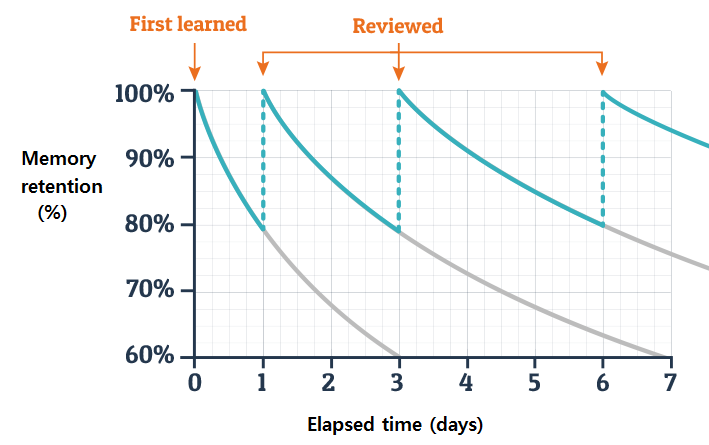
Source: ResearchGate
A relatively easy way to combat this is to make notes. Revisit them everyday during the first week, even if just for 5 minutes! You’ll be able to tell a significant difference in how you’re retaining information.
What are some study tools I can use to learn better?
Great question! Here are some Studydrive faves:
- Notion – Simple, intuitive, top-notch organizational features.
- Miro – Perfect for you, if you’re a visual thinker! Comes with a ton of built-in templates for various phases in your study trajectory.
- Grammarly – Makes editing a dream.
- YouTube – Super effective for clarifying complex concepts as well as for general doubt-clearing.
- TED Talks – Sometimes it’s just easier to learn from a public speaker.
Any tips for last-minute exam prep?
When it comes to last-minute exam prep, flashcards are your best friend. Use an online tool to create as many sets as you like, and revise thoroughly!
When revising notes, colour-coding can be a big help – especially if you’re a visual learner. You can also get a friend or a family member to quiz you in order to promote active recall.
Key Takeaways
Old exam solutions: Make sure to check previous exams in your class. They are the best way to prepare to the specific exam style that will be coming up. If you're not sure how to access them, check if you can find them on Studydrive (and make sure to upload your own exam solutions for the next generation).
Take your time: Try to assess in advance how much time you will spend on exam preparation. Many students don't plan with enough time and get stressed when it's most important not to be so stressed.
Repeat, repeat, repeat: Make sure to repeat everything that's even remotely worthy of repeating. Calculations should be repeated at least once, as well as any type of topic that warrants memorization.
Know your notes: Go through your lecture notes to check if the lecturer highlighted certain topics or issues. These are likely to be relevant for your exam.
Flashcards are your friends: Make sure to use flashcards when you revise, especially in preparation for exams that are heavy on definitions, examples, formulas, etc. Studying with flashcards has been proven to be one of the best ways to memorize.
Get enough sleep: Sleep at least 8 hours each night to ensure your brain adequately processes everything you studied. Sleep also enhances your reaction time and concentration, so it is an essential companion to a healthy study routine.
On Studydrive, you can find all sorts of useful study materials from your peers! Flashcards, exam solutions, lecture and revision notes...we got it all!