Updated on May 14, 2025
Introduction
Game theory, developed by John Nash, is applied in economics, or more precisely, microeconomics, and also in many other fields, such as computer science, law, and psychology. The basic assumption is that each actor has exactly two possible decisions: either cooperation or deflection. Using a so-called player matrix, it is then determined how actor A will behave depending on actor B.
Game theory is a mathematical method or analytical tool that models a decision-making situation involving multiple participants. The goal is to examine the actions and reactions of companies within various competitive scenarios. It is crucial to recognize that the success of each individual player ultimately depends on the actions of their fellow players.
A distinction is made between:
Cooperative Game Theory
- the players / actors can conclude binding contracts with each other
- This type of game theory has a coalition function and is payoff-oriented
Non-cooperative Game Theory
- Here, all strategy choices of the players arise from their own interest, i.e. without concluding binding contracts
- “Non-cooperation” is therefore action- and strategy-oriented
Depiction
Normal Form
- the representation is done using a so-called bimatrix
- all players make their decisions simultaneously (=strategic game)
Extensive Form
- The decisions are represented using a tree diagram
- the actors make their decisions one after the other (=dynamic game)
Important terms and situations within game theory
Nash equilibrium
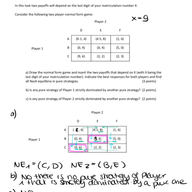
NGG, or Nash Equilibrium for short, allows for solving non-cooperative games. It always occurs when each player chooses the most optimal strategy in response to their opponent's strategy choice. In this equilibrium, none of the players can improve their position by choosing a different strategy.
There are three different types of Nash equilibria:
Nash equilibrium in pure strategy
- Perhaps the most famous example of a pure strategy is the game "Rock, Paper, Scissors." For example, if player A chooses first, player B can respond with the strategy that best suits him. The same applies if player B chooses first and A then responds.
- If the player who chose first were given the opportunity to maintain or deviate from the strategy and stick to his original choice, a Nash equilibrium could also arise here.
Nash equilibrium in dominant strategies
- Each player chooses his or her strategy independently of his or her opponent's strategy choice. The chosen strategy is the one that maximizes the player's utility, i.e., dominates over all other strategies. Thus, there is no incentive for unilateral deviation, and each player would subsequently make the same decision again.
- A well-known example of this is the prisoner's dilemma, which considers the situation of two people who have committed a crime together and are then interrogated separately.
Nash equilibrium in mixed strategies
- Here, chance plays a role, as a probability is determined for each possible strategy of the players. The difference from a game with pure strategies is that a finite game with mixed strategies has a Nash equilibrium.
- To achieve this, the expected utilities of both of the player's strategies must be identical. This is achieved by equating the expected utilities.
Pareto Optimum
This always occurs when neither player can improve without putting their opponent at a disadvantage. It's important to note that a Pareto optimum does not necessarily lead to a Nash equilibrium; the reverse is also true. Furthermore, the Pareto optimum does not necessarily result in maximum overall utility.
Important Keywords
- Prisoner's Dilemma - The prisoner's dilemma presents a situation where two different parties, unable to communicate, must decide between cooperating with each other or not. The highest reward for each party occurs when both parties choose to co-operate. The main lesson is that solely acting out of self-interest might not be the most optimal strategy in a given situation.
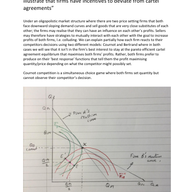
- Cournot's Duopoly - A classic economic model in game theory that describes competition between two firms (a duopoly) where each firm chooses its production quantity - independently and in anticipation of the output of the other firm. This decision is reached without coordination with the other firm. The main lesson is a depiction of how strategic action taken by firms can consequently lead to a particular market outcome.
- Reaction Function - A reaction function, and you may have guessed already, is a predictive plan that specifies how a firm will (or is likely to) react to a move made by its competition.
- Multiple Equilibria - In game theory, multiple equilibria occur when a game has more than one stable outcome. This means that there are likely multiple sets of strategies a player can use to lead to an outcome. Players will benefit from coordinating actions but can choose different points of coordination - meaning that there will be several stable outcomes.
- Pareto Dominance - Pareto dominance is a tenet of game theory. It describes a situation where one outcome is considered more superior than another, if at least one player is better off and no player is worse off. This theory is used to measure the efficacy and impact of viable outcomes.