Q&A with PwC

in Kooperation mit

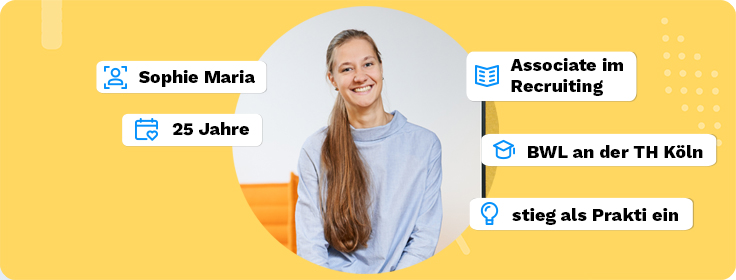
Starting at PwC Germany straight out of college is a dream for many of you. But how do you get there? What's a day-to-day job like at the Big Four firm? Do you use first names? Sophie Maria from PwC answers the community's most burning questions . She started as an intern in February 2020, subsequently joined as a specialist, and has now been promoted to associate, and knows everything about joining the auditing and consulting firm.
Applying to PwC
How can I best prepare for the interview? What technical questions can I expect? Are there personal fit questions? Will the interview be conducted in English or German?
"The important thing to note first: Interviews are always a way for both parties to get to know each other. We need to be a good fit, both personally and professionally, and we can determine that through conversation.
The specialist questions always depend on the respective field; sometimes case studies are used, or you may be asked to talk about your previous practical experience. This often arises during the interview and is at the discretion of the interviewer. The interviews are conducted in both English and German; this also depends on the specialist colleagues conducting the interview. Feel free to ask about this in advance when you receive the invitation to the interview."
What is the weighting between grades and practical experience?
"It's all about the mix! Solid grades are great, of course, but so is practical experience. In addition, we look at the presentation of your application – is it clear, does all the information include it, does the general impression you're giving us of yourself match PwC? At PwC, we also pay particular attention to the potential you bring to the table through your application. If you've completed a project at university or an internship that also fits our topics, or if you have good grades in a relevant subject, these are exciting indicators for us that you have good potential to work with us."
How long does one wait on average for a response?
"We always get back to you as quickly as possible, but it will definitely take a few days. If you've submitted your application to up to three different places, processing will take a bit longer than if you've only listed one vacancy. If you have any questions about the status of your application, you can always contact the person listed as the contact person in the job posting."
More about the Application Process
As an intern & employee at PwC
Can you do a two-month internship or is it only possible for at least three months?
"To truly get to know a field and be able to take on tasks independently, we recommend an internship lasting at least three months. The longer you stay with us, the more topics, people, and projects you'll get to know, and you'll gradually be able to take on and be responsible for more and more tasks. This will allow you to become an increasingly valuable team member during your internship, becoming more independent and confident in your work. A win-win situation for both sides. A two-month internship is therefore rare – but it is possible."
Do you receive documents like letters of recommendation, etc. after the internship?
"After you complete your internship, you will receive a certificate from us listing the tasks you undertook and evaluating your time with us. You can also personally ask your direct supervisor for a letter of recommendation."
How flexible can you be as a working student in scheduling your hours?
"We're very flexible. We simply adhere to the legal requirements (a maximum of 20 hours per week is possible, and 40 hours per week during semester breaks) and the verbal agreements within the team. The students' wishes are discussed with the teams and then implemented in a way that suits both parties. During the exam period, we adjust the number of hours to the needs of the student trainees."

Everyday @ PwC
Why PwC and not another company like KPMG or Deloitte?
"The decision about which company you most see yourself in and feel comfortable in is an individual one, so I can only answer this question for myself.
I decided to apply to PwC because, during my research, I was very impressed by the company's values and the "people" factor, and because I was offered a wide range of development opportunities.
In my interview, my interviewees gave me an authentic picture of PwC and answered all my questions transparently and openly. This gave me a very good gut feeling. During my internship, I was impressed by the trust my colleagues placed in me and how helpful everyone was. The tasks were always exciting, and I felt like a valued team member from the very beginning. This impression was continually confirmed in my subsequent student internship and my entry into the profession, and I'm therefore delighted to have been part of the PwC family since 2020!"
What's the work model? Hybrid, remote, or on-site?
"We've developed a new work mix that allows each team to independently decide which work model to use. Especially since the coronavirus pandemic, the work model has changed and become significantly more flexible. Each department can adapt the work model to the upcoming projects. In most cases, we have an individual mix of flexwork (i.e., flexible work from home) and work in the office or at the client's site. However, there are also teams that work 100% remotely or colleagues who say they prefer to be in the office."
How do the different locations differ?
"PwC has 21 locations throughout Germany, which differ primarily in size. All PwC employees have access to all locations and workstations with their company ID card. Frankfurt is our largest location. However, our teams and project teams are mostly spread throughout Germany. The conditions and opportunities are the same for all PwC employees – only differences may arise with regard to, for example, the range of sports offerings or the size of the canteen."
Should you address your superiors informally?
"Yes, PwC has a informal culture, and you can use the informal "du" for all communication with PwC employees, even when applying."
Compensation & Benefits at PwC
Do you get paid hourly or fixed wages as a Werkstudent?
"As a working student, you receive an hourly wage that exceeds the minimum wage. You enter your hours in our time tracking tool using trust-based working hours, and your monthly compensation is then based on that."
What other benefits are offered (for interns and employees) besides the fruit basket?
"We don't actually have a fruit basket, but our canteens still provide fresh produce. Coffee, tea, hot chocolate, and water are free in the offices. In addition, we offer you extensive development opportunities through project involvement or training courses provided by our Academy. Your IT equipment allows you to freely choose your work location within Germany, so you're not tied to your home. You also receive discounts from various providers. You can also participate in sports programs at any time. Our attractive compensation during an internship is also worth mentioning. We don't differentiate between voluntary and mandatory internships. If you're looking for a company to start your career with during your studies, you can of course network during your internship or student traineeship and use the time to get to know us as an employer. As a career starter, you'll enjoy many more benefits!"
Can you take vacation spontaneously or do you have to wait for several approvals?
"Vacation is always discussed within the team and doesn't require long approval processes. This also makes spontaneous vacations possible. A little preparation time for handing over the upcoming tasks would, of course, be ideal, but if your team lead approves the vacation, you can easily enter it into our system and then enjoy the time off spontaneously."
Are there extra vacation days?
"Extra vacation time can be accrued through our annual working time account (AAP). If you work more than 40 hours per week as an intern, you can either claim the overtime as vacation time or have it paid out. The specific vacation entitlement is stated in your employment contract. This generally results from a statutory full-time entitlement of 20 vacation days per calendar year based on a 5-day workweek. Interns are therefore entitled to approximately 1.67 days of vacation per month."
or