Economics: Monopoly

Definition
A characteristic of a monopoly is that a large number of buyers face only one supplier (the monopolist). This means that the monopolist is the only one selling the product, and there are no equivalent substitutes. The reason for the emergence of monopolies is the prevalence of barriers to market entry, such as patents. The monopolist can therefore control the entire supply side of the market and thus determines not only the quantity offered on the market but also the price of the product.
Characteristics of a Monopoly Market
As the sole producer, the monopolist primarily considers market demand to determine optimal output and price. However, under normal assumptions, market demand is falling, meaning that in order to increase sales volume, the monopolist must reduce prices. This measure, in turn, results in falling marginal revenue (MR). If the monopolist produces at a level of output where MR > MC (marginal cost), the decrease in costs is greater than revenue. At a level of MR < MC, the increase in costs is greater than the decrease in revenue, meaning that if MR ≠ MC, the monopolist loses profits. To maximize profit, the output should therefore be set at a level where marginal revenue equals marginal cost (MR=MC). The price is always higher than marginal cost (P > MC). The more elastic the demand, the closer the price is to marginal cost. The greater the difference between price and marginal costs, the higher the monopoly power and thus the potential price markup.
Monopoly power is therefore determined by a firm's elasticity of demand; thus, monopoly power can exist even when there is more than one seller in the market. It therefore only indicates the ability to set the price above marginal costs. A firm's elasticity of demand depends not only on the elasticity of market demand but also on the number of firms in the market. The more firms there are in the market, the higher the demand elasticities for each firm, which means they have less monopoly power. Furthermore, the interactions between competing firms play a role. For example, if firms enter into illegal agreements to keep prices high, the firms' price markup will be higher than in a more hostile market environment, which can lead to price wars.
Possible Measures of a Monopolist
Monopoly power is no guarantee of profits. The level of profit depends on average costs compared to the price. However, the higher the potential profit, the greater the incentive to engage in practices that lead to greater monopoly power. Companies can, for example, use money for advertising or lobbying (rent-seeking). Another conceivable option is the creation of additional production capacity, even if it is not needed from a production-technical perspective. This is intended to deter potential competitors, as entry would flood the market, causing prices to fall and the new entrant's costs to no longer be covered.
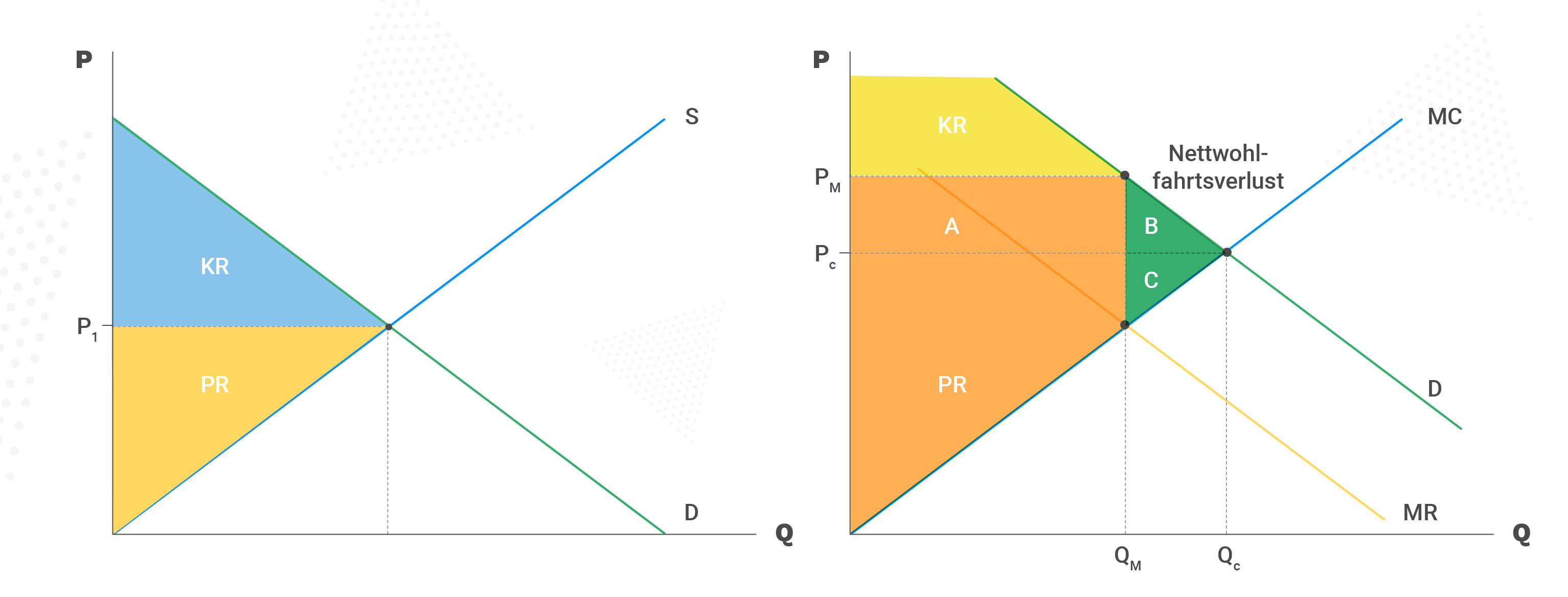
Compared to a competitive market, which represents the welfare maximum, in a monopoly not only are prices higher, but quantities are also lower. Higher prices reduce consumer surplus (=CR), i.e., the total benefit consumers derive above and beyond the price. Even if producer surplus (=PR) increases due to higher prices, there is an overall net welfare loss due to the lower production volume.
For a more detailed understanding, let's look at the graphics above. The left-hand image shows the welfare optimum, i.e., the perfectly competitive market with its optimal production quantity (= QC) and profit-maximizing price (= QM). In the right-hand image, in addition to the monopoly quantity (= QM) and the monopoly price (= PM), the price and quantity from the perfectly competitive market are plotted; these serve as comparison values. Due to the lower production quantity (QM < QC), the supplier loses area C, while at the same time the producer gains area A due to the higher price (PM > PC). Consumers lose area B due to the reduction in quantity. They also pay a higher price, so consumer surplus decreases by area A. Overall, area A is merely an exchanged surplus due to a price change (= price effect). Due to the lower quantity, however, there is a quantity effect, so areas B and C are completely lost. The net welfare effect is therefore: – B – C , which is a net welfare loss.
However, not all monopolies are automatically bad for society. The best example of this is natural monopolies. These arise due to extensive economies of scale and are beneficial to consumers because they can produce at lower costs than would be the case if there were multiple suppliers on the market. Typical examples are industries with extremely high fixed costs, such as public water utilities or the railway network. Such companies are often run by the state (= state monopoly).